Multilingualism at the Heart of the EFIB Project
French is our language of instruction, German is the language of the host country, and English is introduced to students starting in preschool. This gradual immersion allows each student to develop strong language skills while following the French National Education curriculum.
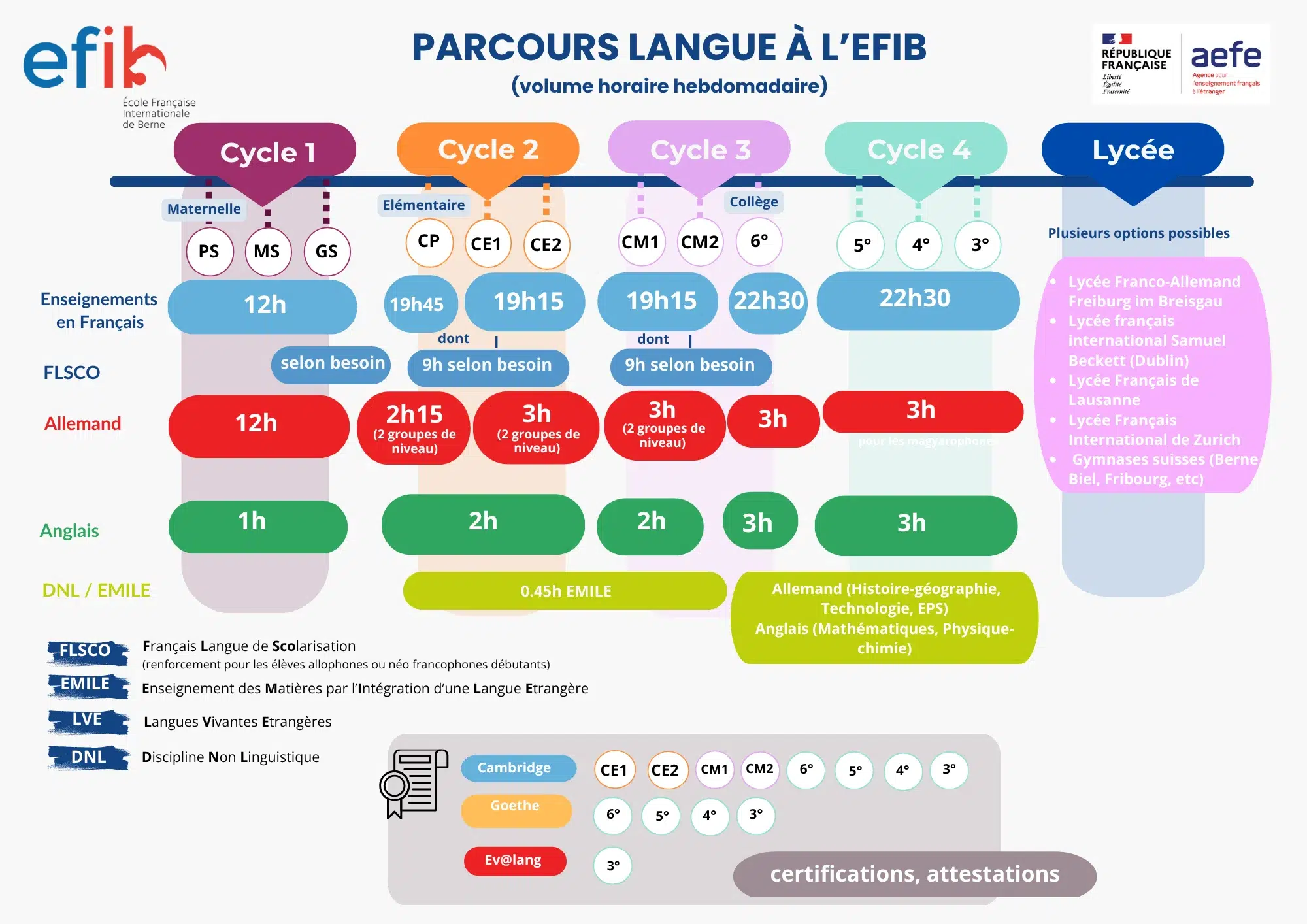
A language learning program designed for each stage of development
French-German Bilingual Preschool
English Starting in
Petite Section
Groups tailored to
language proficiency levels
Support
for Non-French-Speaking Students
Cambridge, Goethe
,
and Ev@lang
French
German
- Up to 12 hours of instruction in preschool
- Groups tailored to the students' level
- Teaching Subjects in German (EMILE / DNL)
English
- Introduction Starting in Preschool
- Continuous Progress Through Middle School
- Skill Groups
- Preparation for Cambridge Certifications (optional)
General questions
My child doesn't speak French. Can he or she enroll in the EFIB?
Yes. Up through first grade, non-French-speaking students can enroll at EFIB without any language prerequisites. In preschool, many children arrive without speaking French and gradually acquire the language through daily immersion, interactions with their teachers and classmates, and teaching methods tailored to learning French as a foreign language.
Starting in elementary school, following a meeting with the family, students may receive specialized support in French as the Language of Instruction (FLSco). A special education teacher then works with the students to facilitate their acquisition of French and promote each student’s academic success.
My child speaks German. How are the German classes organized?
Starting in elementary school, German instruction is organized into groups tailored to the students’ language proficiency levels.
German-speaking students, as well as students who have completed the entire bilingual program from kindergarten through EFIB, join the German-speaking groups. Students who are just beginning to learn German or who need to strengthen their skills are placed in non-German-speaking groups tailored to their level.
This structure enables every student to make progress in a stimulating environment, whether they are native speakers, bilingual, or learners of German as a foreign language.
How do you support students who are just starting to learn German or English?
EFIB welcomes students with a wide range of language backgrounds: complete beginners, bilingual students, and native speakers. To allow each student to progress at their own pace, language instruction is organized into ability groups in certain classes.
This approach allows students to receive instruction tailored to their level while gradually developing their oral and written fluency.
What are CLIL and DNL?
At EFIB, some subjects are partially taught in a language other than French. This approach, known as CLIL (Content and Language Integrated Learning) or DNL (Non-Linguistic Subject), allows students to learn a language while applying their subject-specific knowledge.
The goal is to develop authentic language skills in real-life learning situations, in German or English depending on the level.
What language certifications can students prepare for?
Throughout their schooling, students develop their skills in the school’s three languages and can prepare for various internationally recognized certifications.
These include, in particular:
- Cambridge English certifications (as part of an after-school activity);
- the Goethe-Zertifikat in German (as part of an after-school activity);
- Ev@lang at the end of middle school.
These certifications help highlight students' language skills and prepare them to continue their studies in an international setting.
No one speaks French at home. How can I help my child?
Parents do not need to be fluent in French to support their child’s education. Many subjects, such as math, science, and languages, can be studied regardless of the family’s level of French.
The teaching staff is accustomed to working with international families and can, if necessary, communicate in English or German as well. Specific tools can be put in place to help students understand instructions and keep track of their academic progress.
Will my child be able to join the Swiss system later on?
Yes. The enhanced German language instruction and the incorporation of the canton’s requirements help maintain bridges between the French and Swiss educational systems.
German thus plays a central role in the language curriculum, enabling students to thrive in their host country and confidently explore various academic paths.
“I moved to Switzerland in 2014 when I was 11, knowing almost no French—just a few basic words and phrases. Despite this, at EFIB, I met many people who helped and supported me throughout my academic journey until I earned my brevet in 2018. It’s thanks to them—and to my own determination—that I was able to adapt to a new environment and have so many fantastic experiences.”
Amanda A., former EFIB student
Do you have a question about your child's language development?
Every child has a unique journey. Our educational team is here to answer your questions and help you find the path that best suits your child.